


EDI or AI: How artificial intelligence is revolutionizing order entry
The digitization of B2B processes is at a turning point. While classic EDI systems shaped the exchange of data between companies for decades, they are now reaching their limits. Despite investments worth millions in ERP systems and EDI integrations, order entry in many companies is still largely manual. Artificial intelligence opens up completely new opportunities here.
In this article, you will learn how you can save concrete costs through intelligent order entry and why the combination of EDI and AI is an optimal strategy for automating your processes. In addition, you will receive practical tips for successful implementation in your company.
What is EDI?
EDI refers to the structured electronic exchange of business documents between companies. Since the 1960s, the EDI technology the automatic transfer of orders, invoices and other business documents without human intervention. EDI systems use standardized EDI standards such as EDIFACT or X12 to transfer data between different ERP systems.
Challenges of classic EDI solutions
However, reality shows that EDI is technically complex, format-bound and not very flexible. EDI integrations require complex coordination between business partners on specific data formats and message standards. These IT projects eat up time, money, and human resources. The result: EDI is often only worthwhile for a company's largest, long-standing customers, who typically make up only a small proportion of all business partners.
The introduction of EDI requires complex coordination of formats, message standards and interfaces for each individual business partner. That means: high IT costs, lots of time and tied resources.
For this reason, EDI is usually only worthwhile for the largest and most strategically important customers. The majority of all customers are left out and continue to order via PDF or email. The result: Despite the existing EDI connection, the company still has to manually intervene for all other orders. Clerks once again enter orders manually, which means a significant step backwards in process automation. And even with EDI orders, errors can occur, so that there is also effort involved in checking and reprocessing the orders.

AI integration into EDI processes: More than just automation
In contrast to EDI systems, AI enables flexible order entry. AI solutions are constantly learning and adapting to new formats and customer requirements. They recognize patterns in EDI data, automatically correct errors, and process unstructured data with accuracy that is superior to manual processes. Probably the biggest advantage, however, is that AI is able to map the entire customer network via one interface. The large IT and costs associated with an EDI connection are therefore eliminated, as all customers can be connected in one fell swoop. In concrete terms, this not only means that no complex coordination with every customer is necessary, but the approach also includes smaller customers, for whom an EDI project is not worthwhile anyway.
Artificial intelligence creates new standards for efficiency in order entry
Dealing with unstructured documents: PDF orders and e-mail orders are automatically read out and converted into structured data sets in the ERP system. AI is able to intelligently understand the entire range of order layouts like a human without the need for agreements, templates or previous training.
Validation and error correction: Good AI systems automatically check incoming orders for completeness and plausibility using the master data stored in the ERP system. Missing article numbers, incorrect quantities or inconsistent customer data are identified and corrected. This intelligent analysis significantly reduces error rates and manual intervention.
Dynamic data mapping: Continuous machine learning enables AI to understand new customer formats without manual programming, such as through templates. Each processed order improves recognition accuracy for future orders and expands the understanding of company-specific cases and requirements (e.g. customer-specific article numbers).
The decisive difference to RPA (Robotic Process Automation): While RPA solutions rely on predefined scripts and fail when there are exceptions, AI works flexibly and intelligently.
Use case: Automate order processing with AI-supported document processing
A specific example shows the effect automatic order processing: A medium-sized manufacturing company receives hundreds of orders in various formats every day. The AI solution automatically recognizes the format, extracts all relevant information and prepares the data in a structured way for the ERP system.
If information is incorrect or incomplete, the AI uses master data and customer samples to make corrections independently. An unstructured document is thus turned into a fully validated data set, which is transferred directly to the ERP system. If these validation processes create uncertainties, e.g. because the delivery address is missing or the customer has provided a non-existent item number, solutions such as those from Workist able to ask the team for help. This ensures correct data transmission at all times.
The result: significant time savings with every order, an error reduction of around 80 percent and a significantly improved customer experience through faster order confirmations and more time for customer service.
Benefits for companies
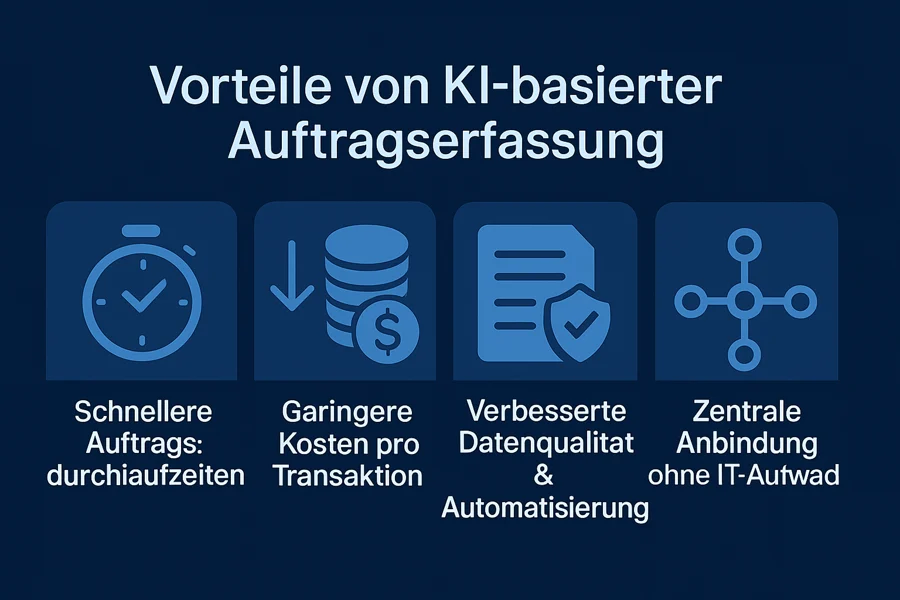
While classic EDI systems show their strengths, especially with large partners, AI-based order entry offers a scalable solution for the entire customer base, regardless of the format or communication channel used. Companies benefit from noticeable efficiency gains, lower process costs and higher data quality.
Faster order turnaround times
AI-based order entry enables processing speed that is comparable with classic EDI systems. Although a correctly imported EDI order can ideally be the fastest option, errors also occur in practice, for example when customers use incorrect formats or information is incomplete. Such discrepancies require manual checks.
On average, AI thus achieves the same efficiency and time level as EDI, but without the high effort required for individual integration projects. All customer formats can be processed centrally and in real time, which means that processes are not only faster but also significantly more robust.
Lower costs per transaction
The decisive advantage: All customers are immediately connected via a system. AI solutions enable all customer orders to be recorded centrally, without complex IT projects and costly coordination. The set-up time is reduced from months to a few days. This modern approach significantly reduces costs per transaction and creates new business models for digital collaboration.
Maximum data quality and automation
Intelligent validation by AI ensures consistent data quality throughout order processing — because good AI systems independently interpret and check read data for accuracy before it is transmitted to the ERP system. Manual intervention is therefore only necessary if, for example, discrepancies between an order and the master data are identified. This combines the highest possible data quality with EDI level automation.
Central connection without IT effort
AI-based systems make it possible to connect all customers via a single system. Individual integration projects, interface development or lengthy coordination processes are completely eliminated. The usual technical complexity of traditional EDI equipment is completely eliminated. And since intelligent AI solutions do not change customer ordering processes, unlike web shops, such systems also do not have to contend with acceptance problems.
EDI integration: sustainable supply chain through intelligent combination
The optimal automation strategy does not rely on “either/or,” but on a coordinated interplay of EDI and AI.
Scalability as incoming orders grow
The largest customers are connected via EDI in order to maximum automation to achieve. The effort is worthwhile for major customers with high order volumes. All other customers can continue to order via PDF, email or Excel as usual, as the AI automatically processes these formats. This hybrid solution enables companies to deal with growing amounts of data while optimizing their existing EDI processes.
Competitive advantage in time-to-order
Companies that rely on this hybrid strategy today gain a sustainable competitive advantage. While competitors are still negotiating individual EDI connections, you can immediately connect every new customer digitally. This type of digital transformation makes it possible to react more quickly to market changes and open up new business areas.
Machine learning for continuous process optimization
Machine learning continuously optimizes business processes. Each processed order improves recognition accuracy and expands the range of orders that can be processed fully automatically. New customer formats are learned automatically, without IT intervention. This continuous development ensures that the system is always up to date and adapts to digital communication trends.
Conclusion: Automate the future of order processing
The EDI KI strategy represents the next generation of B2B integration. Artificial intelligence provides a flexible, scalable solution for digital order entry.
The combination of EDI for major customers and AI for all other business partners maximizes the automation rate with minimal implementation costs. Anyone who uses this technology today is optimally preparing their company for future growth and making optimal use of the effects of digital transformation.
Workist supports companies precisely at this point. The AI-based solution automates the capture of incoming business documents, integrates seamlessly with existing EDI and ERP infrastructures, and ensures consistent processes, regardless of format. Companies benefit from faster processing, higher data quality, and reduced transaction costs, all with minimal implementation effort.
Schedule one now non-binding potential analysis with Workist and discover the automation potential in your company.
FAQ: Common questions about EDI and AI
What is the difference between classic EDI and AI-based order entry?
Classic EDI requires each business partner to be individually connected with standardized formats. AI-based systems, on the other hand, process any format automatically and continuously learn new customer structures. While EDI can only transfer structured data, AI also handles PDFs, emails, and handwritten documents.
For which companies is it particularly worthwhile to add AI to an EDI solution?
Medium-sized B2B companies with many different customers and different order formats benefit in particular. If you already use EDI for a few major customers but still manually enter orders for smaller business partners, AI is the ideal addition. Even companies with growing order volumes and limited IT resources are finding a quick way to automate AI solutions.
What mistakes can be specifically avoided with AI in order entry?
AI systems recognize and correct typical input errors such as outdated article numbers, incorrect quantity information, inconsistent customer master data or missing delivery addresses. Formatting errors in Excel spreadsheets or illegible areas in PDF documents are also automatically corrected. Machine learning continuously improves the error detection rate and achieves accuracy values of well over ninety percent.
Can AI replace or complement existing EDI infrastructures?
AI solutions optimally complement existing EDI infrastructures. You can maintain your working EDI connections to major customers while AI automatically processes all other orders. This hybrid approach maximizes your automation rate without expensive changes to existing systems.
How quickly can AI-based order entry be implemented?
In contrast to EDI projects, which often take weeks or months, a good AI solution is ready for use within a few days. AI systems are pre-trained with large data sets and understand the specific formats of their customers from day one and quickly achieve a high level of processing accuracy. Workist, for example, integrates seamlessly with common ERP systems and can be used productively right away.